loading...
How to Hurdle
Hurdling is sprinting, with bits of wood to make it more ‘fun’.
That is my philosophy of hurdling, and it’s helped me produce athletes who have won multiple county championships, regional championships, and medals at national championships. Of course, to do it well means a lot of hard work and thoughtful technical development, but here are some ideas to get you started.
- Be brave – you have to attack the barriers. Accidents are more likely when you don’t fully commit than when you do. And when you take a tumble, patch yourself up and get back in there.
- Be quick – in a sprint hurdle race, you have 7 or 8 strides before you reach the first hurdle. A practiced hurdler will reach their top speed by the 3rd hurdle.
- Be mobile – you need long, supple hamstrings and good hip mobility if you want to develop a good technique.
- Be willing – you need to learn from your coach, from other athlete and their coaches, and from your mistakes. Watch videos of great hurdlers and compare to videos of you.
- Be disciplined – you will need to cross hundreds of hurdles to improve your technique and become consistent.
- Be tall – work on posture and strength so you can be as ‘tall’ as possible. It’s not about your height – it’s about keeping your hips up. You don’t JUMP a hurdle, you run over it.
- Be rhythmic – sprint hurdling and 400m hurdling are all about modifying your sprinting to accommodate the barriers. There are only 3-strides between barriers in a sprint hurdle race. They don’t move the barriers to match your stride length – you have to learn to match how the hurdles are placed. The rhythm is set – the only way to go faster is to increase the tempo.
- Be adaptable – in 200mH/300mH/400mH the barriers are 35m apart. Athletes typically take between 12 and 18 strides between. Even number of strides means you have to ‘lead’ with alternating legs. As you fatigue during the race you may need to add an extra stride and ‘change down’. An international female 400mH might take 15 strides between H1 to H5, 16 strides between H5 and H8 and 17 strides between H8 and H10, needing two ‘change downs’ and the ability to hurdle with both leading legs.
- Be nice – hurdlers have traditionally been nice to each other – even to competitors. There is so much to learn – share what you’ve learned and listen to others.
I like to start all my beginners to learn the rhythm of the event. I place very low hurdles at a distance that is easy for my athletes to run over. As they become more confident, I gradually increase the distance between the barriers and the height of the barriers. Eventually, we get the barriers to the distance and the height they will be in a race.
Once my athletes are able to run safely over the race specification hurdles I do what’s called ‘ discounting’. I reduce the gap between hurdles, or the height of the barrier. I do this to change the tempo at which the athlete runs, so they get used to moving their legs quicker. Also, running full specification means running flat out, so discounting means athletes can do bigger sessions and cross more hurdles.
I might also change the rhythm on some sessions, usually pushing the hurdles out to 5-strides between. I do this for two reasons;
- When I’m working on technique – taking the rhythmic element away makes it easier to concentrate on technique across individual barriers
- When I’m trying to make my athlete run faster across the ground – by running faster, the athlete reaches the next hurdle faster than they are used to, so has to adapt. I sometimes mix 3-stride and 5-stride hurdle rhythms for the same reason
My typical sessions at Braintree might be:
Sprint Hurdles
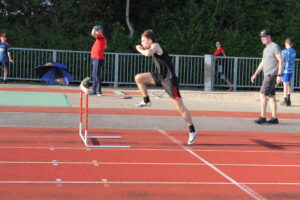
Jacob Korman-Ball showing good lead-leg form – knee first, knee above ankle, foot dorsi-flexed
Tuesday
- Warm-up
- Sprint drills (A-skip, B-skip, C-skip, Ankling, relaxed strides building to full sprints)
- Hurdles walking drills (single stride, 2-forward & 1-backward, over-under) to practice keeping hips tall and opening the hip joints
- One-stride hurdles (to focus on first stride after landing)
- Isolation drills (breaking down the crossing technique and concentrating on individual components)
- Warm-down
Thursday
- Warm-up
- 4x Starts to H2 or H3 on full spec
- 4 x 6 hurdles discounted by 0.3m
- Warm-down
400mH (or 200mH or 300mH)
Tuesday
- Warm-up
- 4-8x 200m – time and recovery based on athlete, but usually fast and not much
- Warm-down
Thursday
- Warm-up
- 4x Start to H3 and 4x H5 to finish
- or Turnabouts – 3 hurdles usually spaced at race distance apart facing one way, and another 3 facing the opposite way in the next lane. Combinations of running one-way turning round and running the opposite way (VERY tiring – useful for steeplechasers)
- Warm-down
If you would like to give hurdling a try, my sessions usually start at 7:00pm, Tuesdays and Thursdays.
The author – Chris Webb
Chris is a England Athletics Level 2 coach. He worked with another local club for a year after a 20-year break, before joining BADAC in 2025. Before taking his break, Chris coached for Bristol AC, Westbury Harriers, Skyrac AC and Trafford AC over a 20-year period, and also at Midlands, Yorkshire and National hurdles squad sessions. His athletes have won medals at county, regional, national and international level. As well as coaching hurdles, Chris has successfully coached athletes competing in combined events, sprints (including relay teams), long jump and triple jump.