Sunday, August 23rd, 2026
Most people in Braintree & District AC will know Denise Larkins, one of our excellent throws coaches, responsible for making BDAC an increasingly strong throws club. Not everyone knows her son Wyatt, or that Wyatt recently won a Bronze medal in the World Junior Championships, throwing a PB of 75.34m.
We asked Denise what it’s like to be the parent of a world-class athlete, and what happened between him arriving for his first training session and standing on that podium in Oregon.
Denise – how did you first get involved in athletics?
My journey into athletics started through my two eldest children. When they first became involved, they were doing javelin but were keen to try the heavy throws, particularly hammer and discus. At the time, Braintree AC didn’t have a heavy throws coach, so there wasn’t really an opportunity for them to explore those events.
I spent around nine months watching them train and gradually became more involved. I was then encouraged to complete the Coaching Assistant course, which would allow me to be there to supervise the throws sessions and support the athletes. I completed the Coaching Assistant qualification in October 2014, initially thinking I was simply doing it so I could help my children.
What I didn’t realise at the time was that this would be the beginning of a completely new journey for me. I quickly found that I really enjoyed coaching and, more importantly, enjoyed seeing athletes develop, gain confidence and achieve things they perhaps didn’t think were possible.
That encouraged me to continue learning and developing my own coaching skills. I progressed from Coaching Assistant onto the Athletics Coach qualification and then went on to complete Athletics Coach Throws Plus (2016), specialising in hammer and discus.
What started as a way of supporting my children has grown into a real passion for coaching and helping other athletes develop. Looking back, completing that first qualification in 2014 was a small step that led to something I never expected, but I’m incredibly grateful that I took it.
What were your personal achievements as an athlete, and when did you become a coach?
At school, I did athletics and my event was javelin. I enjoyed throwing but was never really interested in the track events, so athletics for me was always about throwing. At the time, I didn’t even realise that hammer and discus were events, so it’s quite funny to look back now and see how much a part of my life they have become. I certainly never imagined that years later I would end up specialising in hammer and discus and coaching other athletes in the events.
What can you remember about Wyatt’s first training session?
Wyatt’s first proper athletics session was when he was nine years old. At that age, he was only allowed to take part in running, long jump and shot put. He had spent years watching his older siblings train at Braintree AC, all of whom were throwers, so athletics was already a big part of his life.
For years, Wyatt would come along to the track with us and, while his siblings were training, he would run around the perimeter of the track waiting for us to finish. He was always around athletics, watching what everyone else was doing and naturally becoming familiar with the throwing events.
When he turned nine, he was finally able to start training himself. He began with long jump with Steve, some javelin with Neil, and a little discus and shot put with me. It was the beginning of his own athletics journey, although at that point none of us knew where it would eventually lead.
Did you coach him, and do you still work with him? Who coaches him now?
I started off coaching Wyatt in discus, and it quickly became obvious that he was a natural. He took to the event really well and, at just 11 years old, was selected to represent Essex at the Inter-Counties competition. That experience seemed to give him the competition bug — he absolutely loved it and really thrived on competing.
Not long after that, Wyatt started hammer, following in the footsteps of his older siblings who were all throwing hammer. He took to it incredibly well and still holds the Braintree AC U13 hammer club record today.
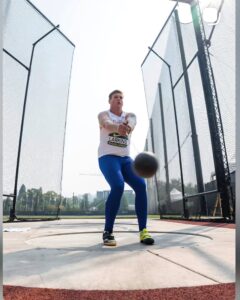
Wyatt Larkins – 3rd – U/20 World Championships, Oregon.
When Wyatt turned 13, we were training at Colchester with Rob Earle, who took an interest in Wyatt and began coaching him. Rob became Wyatt’s coach for several years and played an important part in his development as a thrower.
In 2021, Rob decided to retire from coaching, which meant Wyatt needed to find a new coach. He approached Jamie Bath, who coaches at London Hammer School as well as being the Braintree throws coach. Jamie took him on and has continued to coach Wyatt ever since.
How many miles do you think you drive each year to support his training and competition?
Honestly, more than I can even begin to think about!
Since the age of 14, Wyatt has trained three times a week, travelling between Braintree, Colchester and Lee Valley for sessions. Then there are the competitions — Scotland, Germany, Loughborough, Southend… you name it, and we’ve probably been there! Over the years, athletics has taken us to so many places, and there have been a lot of early mornings, long drives and hours spent sitting trackside.
It’s only recently that Wyatt passed his driving test, and he can finally return the favour by driving me to competitions. Although, if I’m honest, I absolutely love going to watch him compete, so I’m not sure I’ll be giving up my passenger seat anytime soon!
Training is only one part of what goes into being an athlete at this level. Alongside his three weekly throwing sessions, Wyatt also has strength and conditioning sessions, chiropractic appointments and massage, all of which have become part of his routine.
He was also selected for the YTP (Youth Talent Programme) in Loughborough, which gave him the opportunity to develop not just as an athlete but as a person. The programme covered areas such as dealing with pressure, nutrition, psychology and gaining a greater understanding of his event and what is required to perform at a high level.
Having completed the YTP, Wyatt has now progressed onto the TDP (Talent Development Programme). He has just completed his first year and starts his second year next month.
When you look at everything involved — the training, traveling, competitions, strength and conditioning, recovery and the work he puts in away from the track — it really shows just how much commitment goes into pursuing his goals. And as a mum, I’m incredibly proud to have been there for the journey, even if it has involved what feels like half a lifetime of driving!
Do you do wash his training kit?
When he’s living at home, yes…..he’s had to have a big adjustment whilst studying in the USA and do his own laundry!
Do you cook for him? What does a typical day of food look like for him?
Wyatt used to eat pretty much anything — and sometimes probably a little too much! Nutrition wasn’t something we really thought about in any great detail. That changed when he went through the YTP programme, where he learned much more about what to eat, when to eat it and how nutrition can affect performance and recovery.
He now has a much better understanding of what works for him. Before competitions, he has certain foods that he knows work well for him, and he takes snacks with him so that he can keep his energy levels up throughout a long competition day. All of this is something he learned through the YTP and has gradually built into his everyday routine.
His diet now consists of plenty of eggs — around six a day — along with chicken, rice or pasta and lots of fruit. He mainly drinks water and has become much more conscious of making sure he is properly fueled and hydrated.
When he is in the USA, he tends to stick to a very similar routine, eating pretty much the same foods day after day. They also provide him with plenty of protein-based snacks, yoghurts and drinks, which makes it easier for him to keep on top of his nutrition while he is training and competing.
What has been the worst thing about bringing up a world-class athlete? And what has been the best?
The worst thing has to be the time, the traveling and the worry. Athletics becomes a huge part of family life. There are countless early mornings, long journeys, training sessions, competitions, appointments and everything else that comes with supporting an athlete at this level. You’re always thinking about the next competition, whether they’re training well, whether they’re getting enough rest, and whether everything is coming together. As a mum, you can’t help but worry when they’re injured, struggling or going through a difficult period.
There are also sacrifices along the way. Family plans sometimes have to fit around training and competitions, and there have been plenty of weekends spent driving rather than relaxing at home! But you do it because you want to give them every opportunity to succeed.
The best thing, without a doubt, is watching him do something he genuinely loves. Seeing how much he enjoys competing and watching all the hard work he has put in come together is incredibly rewarding. I love watching him compete, and I’m still just as excited now as I was when he first started.
I’m also incredibly proud of the person he has become along the way. Being a world-class athlete isn’t just about how far he can throw; it takes discipline, resilience, commitment and the ability to deal with pressure and setbacks. Watching him develop those qualities has been one of the greatest privileges of being his mum.
And then there are the moments you never forget — traveling to different countries, seeing him compete on big stages and knowing that all those years of training, traveling and sacrifice have helped get him there.
So, if you ask me what the worst thing is, I’d probably say the driving! But the best thing is getting to sit there and watch my son do what he loves at the highest level. And honestly, I wouldn’t change the journey for the world.
What advice do you have for the parents of a talented athlete?
My biggest piece of advice would be to let them enjoy it. When you realise your child has talent, it’s very easy to get caught up in the results, rankings, distances and what everyone else is doing. Try not to let the pressure of performance take away from why they started in the first place.
Support them, but don’t become their coach unless that is genuinely your role. There is a big difference between being a parent and being an athlete’s coach. Find good coaches that you trust and allow them to do their job, while you concentrate on being mum or dad.
Be there for the good days, but perhaps more importantly, be there for the bad ones. Every athlete will have setbacks, injuries, disappointments and competitions that don’t go to plan. They need to know that when they come off the track, they are still your child and that your love and support doesn’t depend on how they performed.
I would also say don’t be afraid to invest in their development, but make sure it’s the right investment. Good coaching, strength and conditioning, nutrition, recovery and education can all make a difference, but there is no need to rush everything. Let them develop at their own pace.
Listen to your child. Their goals need to be their goals, not yours. It’s very easy as a parent to get excited and start thinking about what they might achieve, but ultimately they have to want it themselves.
And finally, enjoy the journey. Take the photos, go to the competitions, celebrate the little milestones and enjoy the traveling. There will be a lot of miles, early mornings and sacrifices along the way, but there will also be some incredible memories.

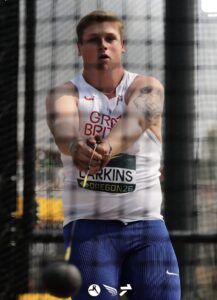
Wyatt Larkins with the mascot at the World U/20 championships in Oregon
For me, the most important thing is that Wyatt knows that I’m proud of him whether he throws a personal best or has a competition that doesn’t go his way. The results are important to him, but they don’t define him — and that’s something I think every young athlete should know.
Note – apologies in advance to the owners of the images used. They arrived without attribution. Braintree & District AC is a not-for-profit organisation that exists to provide a sports club for the local community and therefore no commercial value has been obtained by using these images. Please contact webmaster@braintreeanddistricac.co.uk if you which us to remove any of these images.








© 2026 Braintree & District Athletic Club. All rights reserved. Responsive Web Design