
Wednesday, September 2nd, 2026
In one way, Triple Jump is one of the most bizarre events in track & field. You charge down the runway and do a “hop, skip [step] and a jump” into the pit. Boing, boing, boing – like some demented Tigger. But in another way, it’s one of the most ‘track & fieldy’ of all events, combining speed, strength, coordination and technique into a truly spectacular competition.

Dariya Derkach (Italy) 2026 European Champion
Braintree & District AC has two experienced triple jump coaches (Chris Webb and Steve Partridge), yet we only have one or two members who occasionally compete at triple jump. So, we thought we’d reveal some of the secrets of this brilliant event to coax a few more ‘Tiggers’ to take part.
Male and female athletes can both do Triple Jump, though UK Athletics recommends that competitions should be for U16s upwards (13-15 year-olds).
Note – Steve and Chris will only work with athletes under 14 in exceptional circumstances, due to Triple Jump’s physical demands.
Sportshall athletics and Funethics competitions may include Standing Triple Jump and 5-bound combo jumps for younger age groups.
Triple Jump (TJ) is one of the four recognised jumps disciplines in Track & Field, alongside Long Jump, High Jump and Pole Vault. But unlike those which require a single explosive effort, TJ requires three explosive efforts, plus two managed ‘absorptions’ of energy.
The essential requirement is to build speed, and hang on to as much of it as possible as you go through the three jump phases – Hop, Step and Jump.
SLOWLY! Learn the rhythm and basic technique of the event before you go flying down the runway. You need to start with a standing jump before progressing to 3, 5, and 7 stride run-ups.
When going from a standing start, stand on one leg and hop forwards. You can chant a little mantra – SAME, OTHER, BOTH – to help you land on the correct foot after each phase.
Once you’ve mastered the rhythm from a standing start you can add strides to start building momentum – and you’ll find you can jump further. You WILL eventually find that adding more stride (and therefore more speed) stops adding distance to your jump. That’s when it all starts to get technical.
There are two areas here – take off and the jump itself.
Just like long jump, there are rules about how you take off, the main one being that you don’t overstep the take-off board. That means that you have to develop a solid, consistent run-up.

Daniel Falode – UK Triple Jump Champion
And that means working out where you start from and then starting and running in the exact same way EVERY TIME you jump – until your coach says that it’s time to change something.
Note – Coaches can’t tell you how to adjust your run-up if you do something different each time you run down the runway. The more complicated is the way you start your run-up, so the more opportunities for variation in your run-up – Keep It Simple, or get used to fouling the board.
As for refining the jump technique itself, there are many variations.
Male TJ athletes tend to try to balance the three phases, trying to get them as equal as possible (though the 2nd phase step is always shorter than the other two phases). On the other-hand, the trend in international women’s TJ is to sacrifice phase 2 in order to maximise phases 1 & 3.
Arms are also a big debating point. Many beginners use their arms in an exaggerated movement that is otherwise like sprinting. More advanced athletes often try a “double arm shift.”
But whatever you do, the aim is to maintain balance and forward momentum.
SPRINTING – like Long Jump, it’s a speed event, so you need some speed. Admittedly, it’s not quite as fast as Long Jump – but world record holder Jonathan Edwards had a 100m pb of 10.48 sec, and could jump 7.41m in Long Jump.
Here’s a short video of Jonathan Edwards explaining the event: https://www.facebook.com/reel/1938698983505147
Admittedly, not everyone is going to have their sights on an 18.29m world record (he also did 18.43m wind assisted), but Edwards has set a standard that hasn’t been beaten in 31 years – and all those who have got close to his mark are similarly fast.
You also need to work on plyometrics – both quick reactions against the ground (like a sprinter) AND being able to absorb impacts. Indeed, the very best TJ athletes need to absorb forces during their jump of up to 18 times their body-weight as they land their 2nd phase. That means working on both small, quick movements, and the bigger movements you get with box bounding.
Older athletes would also benefit from explosive weight lifting.
And of course, technique work. Given the event’s demand for speed and the forces experienced, full-out jumps don’t form the core of Triple Jump technical training. You’d need to do jumps from a shorter run-up to be able to complete a viable session. Or else, concentrating on individual parts of the jump.
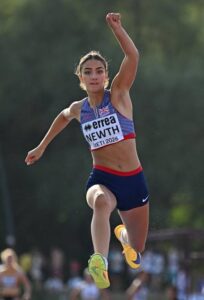
Leila Newth – UK U18 Triple Jump Champion
You might also use a low box or spring board to practice landing a phase, training the ability to absorb force without collapsing the technique.
Putting the whole lot together with a full run-up is exhilarating, but not something you do week in, week out.
If you want to be a regular part of your club’s team, Triple Jump athletes are always in short supply, and that also provides good opportunities at championships and trophy meetings.
If you’d like to know more about Triple Jump, please speak with Chris Webb or Steve Partridge – we’d be delighted to work with you.
Note – apologies in advance to the owners of the images used. They arrived without attribution. Braintree & District AC is a not-for-profit organisation that exists to provide a sports club for the local community and therefore no commercial value has been obtained by using these images. Please contact webmaster@braintreeanddistricac.co.uk if you which us to remove any of these images or add attribution.








© 2026 Braintree & District Athletic Club. All rights reserved. Responsive Web Design